


OEM Magnetic Phone Cases: How to Verify Compatibility Before Bulk Orders
Before placing a bulk order for OEM magnetic phone cases, approve samples against the exact phones, chargers and accessories your customers will use. Check physical fit, magnetic attachment, charging behavior and accessory clearance separately. Record the combinations that pass, any conditions of use, and the evidence behind certification claims. A case that attaches firmly to one charger has only passed one part of that review.
For private-label brands and distributors, this matters most when one design is sold across several phone models. A familiar-looking magnetic ring can hide differences in positioning, case thickness and camera clearance. The practical goal is a compatibility list your sales team can explain and your supplier can reproduce.
What does “magnetic compatibility” actually cover?
A useful specification separates four questions: does the case fit the phone, does the intended accessory attach correctly, does the charging setup work as claimed, and is any certification statement supported for that exact product? Give each question its own acceptance check.
Magnetic attachment and wireless charging
A passive magnetic case can help position an accessory. It does not add a wireless charging receiver to a phone or upgrade the phone’s charging protocol. Start with the handset manufacturer’s specifications, then evaluate the case on that handset.
Apple explains that actual MagSafe charging power depends on the iPhone model, power adapter and system conditions. Its guidance also distinguishes charging behavior on non-MagSafe Qi-compatible devices. That is why a charger’s advertised maximum should not become an unconditional speed claim on a phone-case listing. See Apple’s MagSafe charging guidance.
Qi2, Qi2 Ready and certification language
Qi2 certification and a general “magnetic” description are different claims. The Wireless Power Consortium (WPC) describes Qi2 Ready phones and accessories as delivering the full Qi2 experience when paired in approved combinations. If a supplier proposes Qi2 Ready wording, request the approved phone-and-case combination, rather than assuming that every case with a ring qualifies. See the WPC explanation of Qi2 Ready.
For a claimed Qi-certified product, use the WPC certified-product lookup and match the listed identity to the supplied model. A certificate for a charger, another case model or a component does not establish the claim for the product you are ordering. Ask for the applicable documentation before approving packaging or marketplace copy.
Build a compatibility matrix before requesting samples
Send the supplier a short test matrix with the RFQ. “Compatible with magnetic accessories” leaves too much open. Name the phone variant, the case revision and the accessories that matter to your sales channel. Mark an untested combination as untested; do not inherit a pass from a neighboring model.
| Combination to record | What to check | Evidence to retain |
|---|---|---|
| Exact phone model and case SKU | Seating, buttons, ports, camera opening and screen-protector clearance | Model identifiers, sample revision and fit photographs |
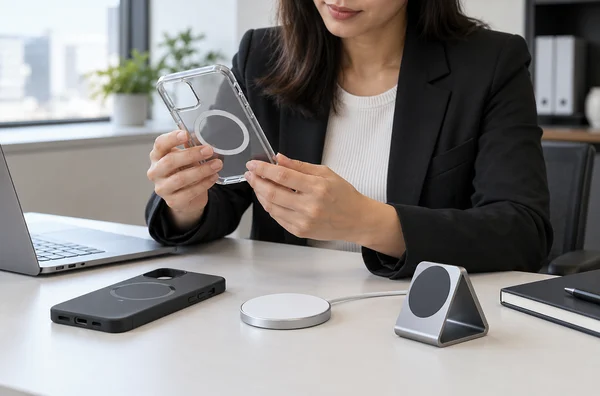
| Phone, case and named charging puck | Contact, alignment, charging initiation and continuity | Charger and adapter models, cable, conditions and charging log |
| Phone, case and charging stand | Camera-bump interference and portrait/landscape support | Photos in each intended orientation and observed limitations |
| Phone, case and magnetic power bank | Attachment, camera clearance, connector access and charging behavior | Power-bank model and a record of the assembled setup |
| Phone, case and wallet or grip | Rotation, sliding, removal and contact with buttons or cameras | Accessory model, agreed handling method and result |
| Phone, case and vehicle mount | Retention under the agreed mount and movement conditions | Mount identity, test fixture or method, load and result |
| Foldable phone and case | Opening, closing, hinge movement and accessory clearance | Results for the intended folded and unfolded configurations |
Add columns for pass, fail, conditional pass and not tested. A conditional pass needs a usable instruction, such as removing a detachable wallet before charging. An unexplained tick in a spreadsheet is not enough for a buyer to approve a product claim.
You do not need to test every accessory on the market. Choose the models you plan to name, bundle or recommend, plus representative shapes relevant to your customers. A flat puck and a large power bank can contact the same case differently. Keep the final claim within the tested scope.
Inspect the complete case before testing charging
Check fit on the correct handset
Use real devices for final sample acceptance. A dimensional dummy can help with early fit reviews, but cannot confirm charging behavior or phone functions. Record the handset’s full model designation. Similar screen sizes do not establish interchangeable case fit.
Install and remove the case using the intended method. Check that corners seat fully, buttons operate without being held down, connectors can enter the port, and the camera opening does not obstruct the lens or flash. If the range targets stylus-equipped phones, include stylus storage and normal input operation in the review.
Review the ring, back panel and finish as one assembly
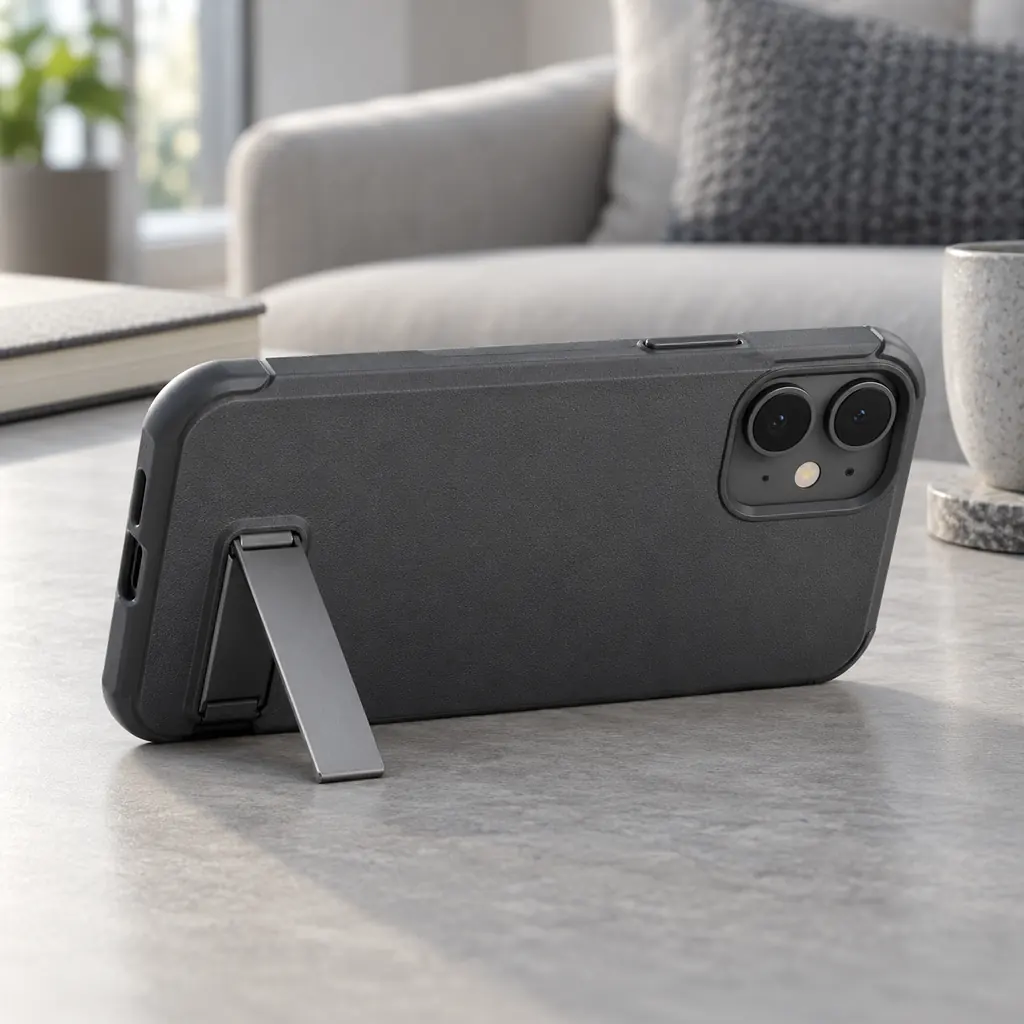
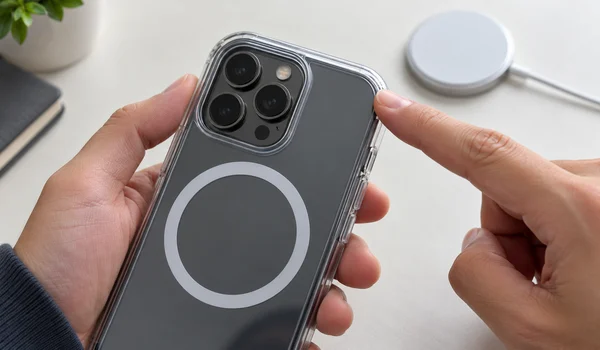
Ask for the magnet layout and its position relative to the phone, with tolerances on the approved drawing where relevant. Record the finished back-panel construction, including coatings, decorative layers, liners and any ring or stand assembly. Approving a loose magnet or unfinished shell leaves the final assembly untested.
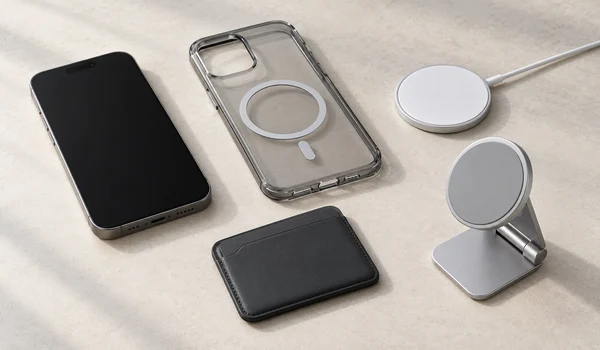
Inspect for loose parts, exposed edges, uneven surfaces and movement in an integrated ring. Check whether the charger sits flat or bridges across a raised feature. If the material stack changes after sampling, return to the affected compatibility tests. For the broader material decision, see our TPU, PC and silicone phone case comparison.
Run a repeatable charging check
The steps below are a suggested purchasing acceptance method. They are not a certification procedure, and they do not describe test results for a DUX DUCIS product. Agree the equipment, duration, sample quantity and acceptance limits with the supplier before evaluating the samples.
- Identify the phone, operating-system version, charger, adapter and cable. Follow the equipment manufacturer’s instructions and record the starting battery level and ambient conditions.
- Establish a reference run using the phone without the case, or with a suitable approved reference case where the intended charging arrangement requires one. Keep the setup comparable.
- Repeat with the finished OEM sample. Check whether charging begins normally, whether the charger seats correctly and whether small repositioning during ordinary placement causes interruptions.
- Observe charging for the agreed interval. Log interruptions, warnings, unexpected stops and any thermal limitation messages. Keep phone use, screen activity and starting conditions consistent enough for the comparison to be meaningful.
- Repeat the relevant check with each charger or accessory included in the compatibility claim. Investigate a failed combination before approving the claim or revising the product.
A charging animation confirms that charging has started; it does not establish sustained speed. Battery percentage alone is also a weak basis for an exact wattage claim. If your listing needs a measured power or charge-time statement, agree a suitable measurement method and disclose its conditions. Power measured at the adapter input is not the same as power delivered to the battery.
Keep temperature observations in context. Apple notes that warmth during wireless charging can be normal and that software may limit charging when the battery becomes too warm. Use the equipment makers’ guidance and qualified testing for safety questions; do not invent a universal case-temperature pass limit.
Test wallets, ring stands and mounts separately
Attachment needs a defined use condition
“Strong magnets” is difficult to audit. Ask what was measured, with which accessory, in which direction and on which finished sample. A straight pull-off result does not answer whether an accessory slides sideways, rotates or detaches under movement.
For a mount, define the phone-and-case load and the intended mounting arrangement. For a wallet, assess ordinary handling and removal. For a grip or ring stand, check the intended opening positions and repeated operation using an agreed method. Set numerical limits only after the buyer and supplier have established what they need to represent. Avoid printing an impressive force figure without its test conditions.
Check clearance with the actual accessory
A power bank may extend into the camera surround even when its magnetic ring aligns. A charging stand may support one orientation but leave another unstable. Examine the assembled products from the side as well as the back, and photograph any gap or interference that affects use.
Wallets and card holders need clear charging instructions. Apple warns against placing items such as cards and security badges between the phone and MagSafe Charger. If the case has a removable wallet, specify when it must be removed and include that condition in the sample review and consumer instructions.
For foldable models, assess the configurations customers will actually use. Check hinge clearance and whether an attached accessory obstructs opening, closing or stable placement. Do not extend a result from a conventional phone shell to a foldable design without its own review.
Turn the approved sample into a production specification
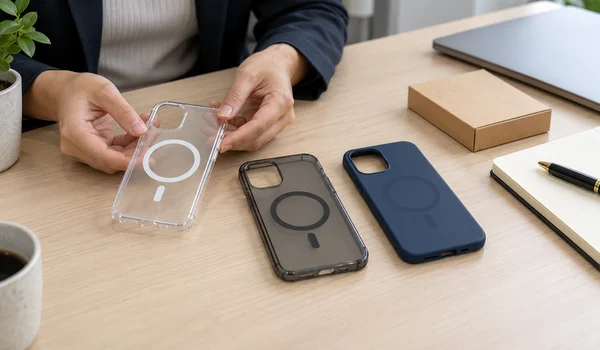
Before releasing a bulk order, link the approved sample to a dated revision and keep a matching reference with the supplier. The approval record should identify the case SKU, phone variant, color or finish, ring assembly and packaging version. Record which differences between variants require another sample check.
Agree how production units will be inspected. The inspection plan should state the sampling method, defect categories and what happens when a result falls outside the agreed limits. Keep first-article or pre-production approval distinct from final shipment inspection. A good development sample does not establish that every production batch is identical.
- Retain the compatibility matrix and the equipment list used to approve it.
- Save dated photos and test records with the relevant sample revision.
- Identify changes that trigger review, including magnet layout, adhesive, back-panel thickness, decorative layers and supplier substitutions affecting the assembly.
- Agree the handling of failed units, rework, reinspection and any claim that must be narrowed.
- Match the approved product names and usage conditions across the carton, insert and online listing.
Separate a compatibility failure from a cosmetic disagreement in the inspection report. “The case looks correct” and “the specified charging combination passes” need different evidence. Broader supplier qualification belongs in a separate review; our OEM phone case manufacturer selection guide covers that process.
What to include in your OEM magnetic phone case RFQ
A supplier can quote more accurately when the compatibility scope is visible at the start. Include:
- The exact phone models, target quantities by model and color, and intended markets.
- The case construction and functions you want, including any integrated stand, wallet or removable accessory.
- The named chargers, power banks and mounts that need to work with the case.
- The proposed sample tests, evidence required and who will approve the results.
- The intended compatibility and certification wording, with documentation required for each claim.
- Packaging, logo and insert requirements, including any accessory-removal instructions.
- Requested sample and production milestones, with shipping time quoted separately.
For an iPhone-focused range, start with the DUX DUCIS iPhone case category and shortlist designs for model-specific review. To discuss an OEM magnetic case project, send DUX DUCIS your phone-model list and accessory requirements. Ask for the proposed sample configuration and supporting evidence before committing to a bulk compatibility claim.
Frequently asked questions about OEM magnetic phone cases
1. Does a magnetic phone case add wireless charging to any phone?
No. A passive magnetic case does not add charging electronics to a phone. Verify the handset’s wireless charging support first, then evaluate the finished case with the intended charger. A magnetic attachment result alone cannot establish that the phone will charge.
2. Is a magnetic case automatically MagSafe or Qi2 certified?
No. A magnetic ring or a compatibility description is not proof of certification. Ask for documentation tied to the exact product and claim. For Qi-certified products, match the model to the WPC database. Do not treat a charger’s certification as certification of the case.
3. What does Qi2 Ready mean when buying cases?
WPC describes Qi2 Ready devices and accessories as providing the full Qi2 experience in approved combinations. Buyers should verify the specific phone-and-case pairing and its supporting certification records. A general magnetic case should not be assumed to qualify simply because it attaches to a Qi2 charger.
4. Can one sample approve a case range for several phone models?
One sample establishes evidence only for its tested configuration. Different phone variants can change fit, camera clearance and charging alignment. Create a model-by-model matrix and agree which variants need separate tests. Record any grouping rationale rather than automatically extending a pass across the range.
5. How should a buyer specify magnetic strength?
Define the intended accessory, phone-and-case load, test direction and handling conditions before setting a limit. Evaluate sliding and rotation when those movements matter. Keep the measurement method with the result so the supplier and buyer can repeat the same check on production samples.
6. Can a magnetic wallet or ring stand stay attached during charging?
That depends on the design and the tested charging setup. Check whether the accessory prevents proper contact or introduces material between the phone and charger. Follow the charger and phone makers’ instructions, remove cards or other sensitive items from that space, and state any removal requirement in the product instructions.
7. How can buyers verify a fast-charging claim?
Identify the exact phone, charger, adapter and cable, then agree a measurement method and operating conditions. A charging icon or magnetic connection is insufficient evidence for a speed claim. Report only what the test supports, and avoid presenting the charger’s maximum rating as guaranteed phone charging power.
8. What should be approved before a bulk order?
Approve the finished sample revision, model-specific compatibility matrix, acceptance method and production inspection plan. Confirm packaging claims and their supporting evidence, plus any instructions customers must follow. Document changes that require retesting so the bulk goods remain tied to the configuration that was approved.