


Foldable Phone Cases: Front-Frame Fit and Hinge Clearance Before Bulk Orders
Before ordering foldable phone cases in bulk, check whether the front frame stays seated as the phone opens and closes, whether the hinge cover moves without interference, and whether customers can install and remove the case using the supplied instructions. Review the exact handset, case and cover-screen protector together.
A case can look aligned in a closed product photo yet lift at the front edge during opening. Another may fit correctly only after an adhesive pad has been installed as directed. The buying decision depends on the cause: a design fault needs a correction; an installation problem needs usable instructions.
Identify what holds the front frame in place
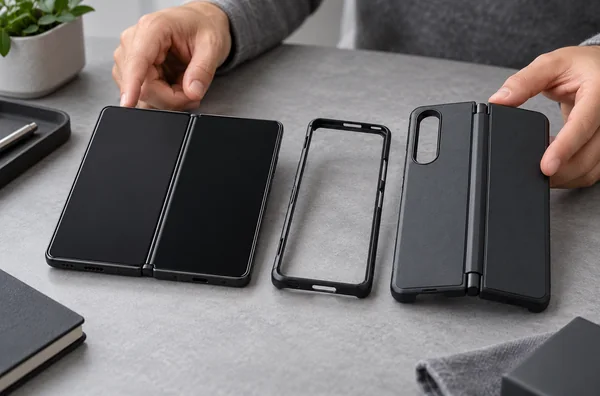
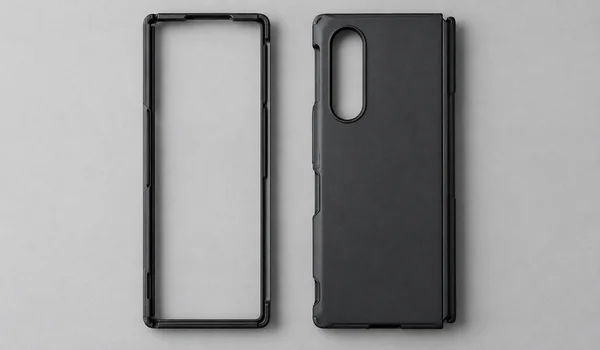
Ask the supplier how the front frame is held in place. It may rely on its shape, adhesive pads or a connection to the rear shell. Some designs combine these features. Some designs have no front cover. Ask the supplier to identify the retention method rather than assuming every foldable case works the same way.
For a design with adhesive pads, request the pad locations, installation instructions and replacement policy. Confirm whether spare pads are included, available separately or not intended for user replacement. A frame that has been removed and refitted with a used pad may not represent the installation a customer receives.
Samsung’s Galaxy Fold and Flip cover guidance notes that dust and oils can affect attachment and that the adhesive force of its non-slip pads strengthens over time. It also highlights the small adhesive area on the front-left pad of the Fold cover. For your selected case, ask the supplier to specify the installation conditions before the review.
Make installation part of the fit review
Give the proposed customer instructions to someone who has not fitted the sample before. Watch where they hesitate or need help. If the salesperson has to explain a step, check that explanation and add it to the leaflet.
Before starting, record the following:
- The exact handset model and case SKU or revision, including the front and rear pieces.
- The cover-screen protector or film, if the case is intended to work with one.
- The supplied adhesive pads and whether they are new, previously used or replaced.
- The instruction version, required surface preparation and installation sequence.
- Any specified pressing method or waiting period before handling.
Follow the selected product’s instructions. Do not invent a universal waiting period or substitute stronger tape to make a sample pass. If the supplier has not specified an important installation condition, resolve it before comparing results.
Watch the frame through the whole opening movement
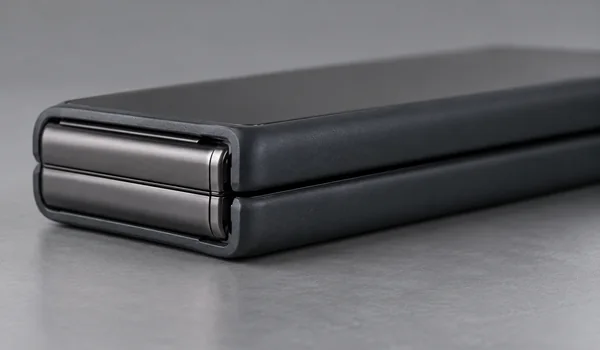
Inspect the seated case while the phone is closed, through its intended intermediate positions and when open. Watch the narrow front edge as well as the hinge cover. Record whether a corner lifts, the frame shifts, a pad becomes exposed, or one case component catches another. Check the handset’s normal movement without the case if a comparison is needed.
Do not force the phone through resistance or insist on an arbitrary opening angle. Stop and investigate unusual resistance, scraping or contact with vulnerable areas. A short video taken from the side can show where the movement changes more clearly than separate open and closed photographs.
The table below is a suggested purchasing review, not a certified test method. Agree the conditions and acceptance criteria for your selected design before using it to release an order.
| What you observe | What to check next | What to record before acceptance |
|---|---|---|
| Front edge lifts immediately after fitting | Correct model, seating sequence, clean contact surfaces and pad preparation where applicable | Installation conditions and whether a correctly fitted sample still lifts |
| Frame shifts only while opening or closing | Point of contact between the hinge cover, front frame and rear shell | Video of the affected position and the supplier’s correction or explanation |
| Protector edge lifts or the case will not seat | Exact outer-screen protector model, placement and case clearance | The supported case-and-protector combination or a clearly stated exclusion |
| Frame stays attached but obstructs screen gestures | Access to the cover-screen edges during intended use | The affected gesture or control and the result after any revision |
| Fit changes after removal and refitting | Removal method and whether pads must be replaced | Pad condition, refitting instructions and results with the specified replacement parts |
| Movement becomes rough or leaves visible marks | Interference, trapped debris and the affected contact surfaces | Photos, inspection findings and resolution before further handling |
A lifted edge alone will not tell you whether the problem is installation, protector compatibility or case geometry. Ask the supplier to investigate, then repeat the check under the corrected conditions.
Check the cover-screen protector as a named combination
Samsung’s Fold7 and Flip7 case attachment guide warns that a thick film or third-party protector on the cover screen can prevent proper case fit. It also directs users to the instructions for their particular case. Check the combination rather than treating all third-party protectors as incompatible.
If your retail offer includes a protector, review that exact item with the case. Look for edge contact, lifting and loss of access to screen gestures after the frame is fitted. If you sell the case alone, make any protector compatibility statement specific enough for a customer to use.
This check concerns the outer cover screen. Do not remove or modify a factory-installed folding inner-screen layer to make a case fit. Follow the handset manufacturer’s care instructions.
Confirm removal, refitting and customer instructions
Ask how the case should be removed before attempting it. The instructions need to identify the release points for this case and handset, and explain what happens to any adhesive pads afterward.
For its Fold7 and Flip7, Samsung’s case-removal guidance says to keep the device folded, avoid excessive pressure on the screen, buttons, hinge and inner frame, and avoid sharp removal tools. Do not copy a corner-pull sequence from another model into your own leaflet without confirming it applies.
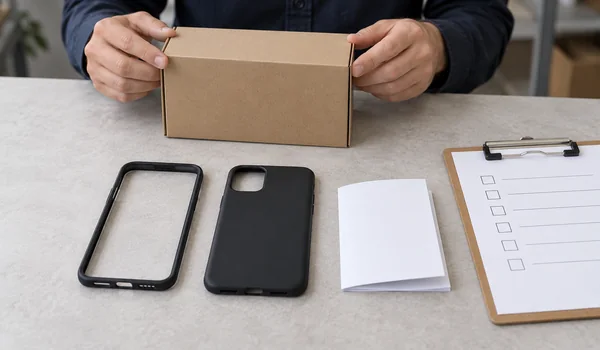
Review the leaflet alongside the actual supplied parts. It should distinguish removable adhesive backing from phone screen layers, identify the correct fitting sequence and explain any restrictions on reuse. Where replacement pads are required, confirm how customers obtain the correct parts. Do not describe a case as suitable for frequent swapping unless the agreed review supports that use.
Keep fit checks separate from service-life claims
Opening and closing a sample during a fit review can reveal interference. It cannot establish how long the case will last. If repeated-use durability is part of your buying requirement, agree a separate protocol with the supplier: sample quantity, opening movement, speed, conditions, number of cycles, inspection intervals and permitted changes.
This fit review sets no cycle-count requirement. A phone manufacturer’s hinge-life claim does not establish the life of an aftermarket case, its hinge cover or its adhesive pads. Likewise, a hinge cover’s presence alone does not demonstrate drop performance or make the assembly dustproof.
Send a focused brief for your foldable case order
Utilice la DUX DUCIS foldable phone case range to identify the design you want reviewed. Send the exact device model, product reference, intended cover-screen protector and your expectations for installation, removal and repeated use. Ask which retention features and instructions apply to that SKU.
Leave the affected configuration on hold while lifting, rubbing or obstruction remains unresolved. Once the selected configuration works under the agreed conditions, connect those results to the sample approval record. For OEM or ODM enquiries, request written confirmation of the case configuration and any changes needed before the bulk order proceeds.
Frequently asked questions about foldable phone case fit
1. What should a buyer check first on a foldable phone case?
Confirm the exact handset and case revision, then identify how the front section is retained. Fit the case using its intended instructions and watch the front frame and hinge cover through normal opening and closing. Record lifting, movement or interference rather than approving the design from a closed photograph.
2. Do all foldable phone cases need adhesive pads?
No. Retention depends on the selected design, and some cases have no front cover. Ask the supplier how each part is secured. If pads are used, confirm their preparation, installation and replacement instructions. Do not assume that an adhesive-free design is automatically more secure or easier to remove.
3. How long should adhesive pads settle before checking fit?
Use the period specified for the selected case and pad. Do not apply a universal waiting time across different products. Record the installation and waiting conditions so the supplier can interpret the result. If no instructions are supplied, ask for clarification before treating immediate handling results as final.
4. Can a screen protector make a foldable case appear to fit badly?
Yes. A cover-screen protector can interfere with seating or be lifted by the frame. Check the exact protector and case together, including access to edge gestures. Keep the compatibility result specific to that combination, and do not alter the folding inner-screen layer to solve a case-fit problem.
5. What should happen if the front frame moves when the phone opens?
Record where and when it moves, then check the installation, pad condition where applicable and contact between case components. Stop if there is unusual resistance or damaging contact. Ask the supplier to resolve the cause and repeat the check on the corrected configuration before accepting it.
6. Can the same adhesive pads be reused after removing the case?
That depends on the product’s instructions. Confirm whether removal requires new pads and whether the correct replacements are supplied or available. Record pad condition when comparing samples. Do not assume a refitted sample with used pads represents either a fresh installation or approved repeated use.
7. How many opening cycles prove that a foldable case is durable?
A basic fit review does not establish a durability rating. Agree a separate repeated-use test with defined movement, conditions, sample quantity, inspection intervals and acceptance criteria. Do not transfer a handset hinge-life claim to the case or choose a cycle number without an agreed purpose and method.
8. What should a buyer send DUX DUCIS for a foldable case review?
Send the exact handset model, case reference, intended cover-screen protector and target order quantities. Describe the required installation, removal and repeated-use conditions. Include photos or videos of any fit concerns, and ask for the applicable retention details, customer instructions and sample configuration before approving the order.